Packaging
Delivering an expanded toolkit
Secondary packaging helps beverage brands increase engagement with consumers
By Jessica Jacobsen
(Image courtesy of BERO)
People sometimes need that extra push to start a new project or begin a new routine. As sustainability is becoming a bigger part of consumers’ lives, their interests are pushing brand owners to rethink their secondary packaging options.
“Consumers and retail partners are much more aware of the environmental impact of secondary packaging than they were even a few years ago,” says Aytunc Atabek, co-founder and chief operating officer at NoBiggie. “That is pushing brands toward packaging that is more recyclable, uses less plastic, and is easier to justify from a sustainability standpoint. At the same time, it still must work commercially.
“Secondary packaging needs to protect the product, merchandise well, and support the brand on shelf,” he continues. “The best solutions are the ones that reduce unnecessary material without making the pack feel cheap or less effective.”
Bret Arnone, vice president of sales at Graphic Packaging International, explains that sustainability is resetting expectations for secondary packaging, as brands shift away from plastic shrink film and rings toward more circular, fiber-based alternatives. However, that transition is happening at different speeds, he notes.
“Where there is less regulatory pressure, many brands are taking a more incremental approach by optimizing packaging rather than fully replacing materials,” Arnone says. “Brands are reducing overall footprint through lightweighting, increasing recycled content where appropriate and refining designs to use less material — delivering both environmental benefits and, in many cases, cost savings.”
This approach has led to a more nuanced meaning of sustainable packaging, he adds.
“Beyond recyclability or compostability, it includes factors such as material efficiency, use of renewable or recycled inputs, and carbon impact,” Arnone says. “At Graphic Packaging, we evaluate these factors through multiple lenses, including drawing on metrics like lifecycle analysis, the Material Circularity Indicator (EMF) and recyclability as the innovation requires.
“These shifts are driving a broader range of formats, from wrap and clip-style multipacks to basket carriers and fully enclosed cartons,” he continues. “This expanded toolkit gives beverage producers greater flexibility to balance sustainability goals with cost, performance and operational needs.”
Yet, sustainability isn’t the only factor impacting secondary packaging material selection.
“Convenience continues to be a major driver in secondary packaging design,” Arnone explains. “Time-constrained consumers are looking for multipacks that are easy to grab and go, often with integrated handles or intuitive opening features. There is also growing demand for formats that transition easily from store to home, such as packs designed to be placed directly in the fridge or used for easy at-home dispensing.”
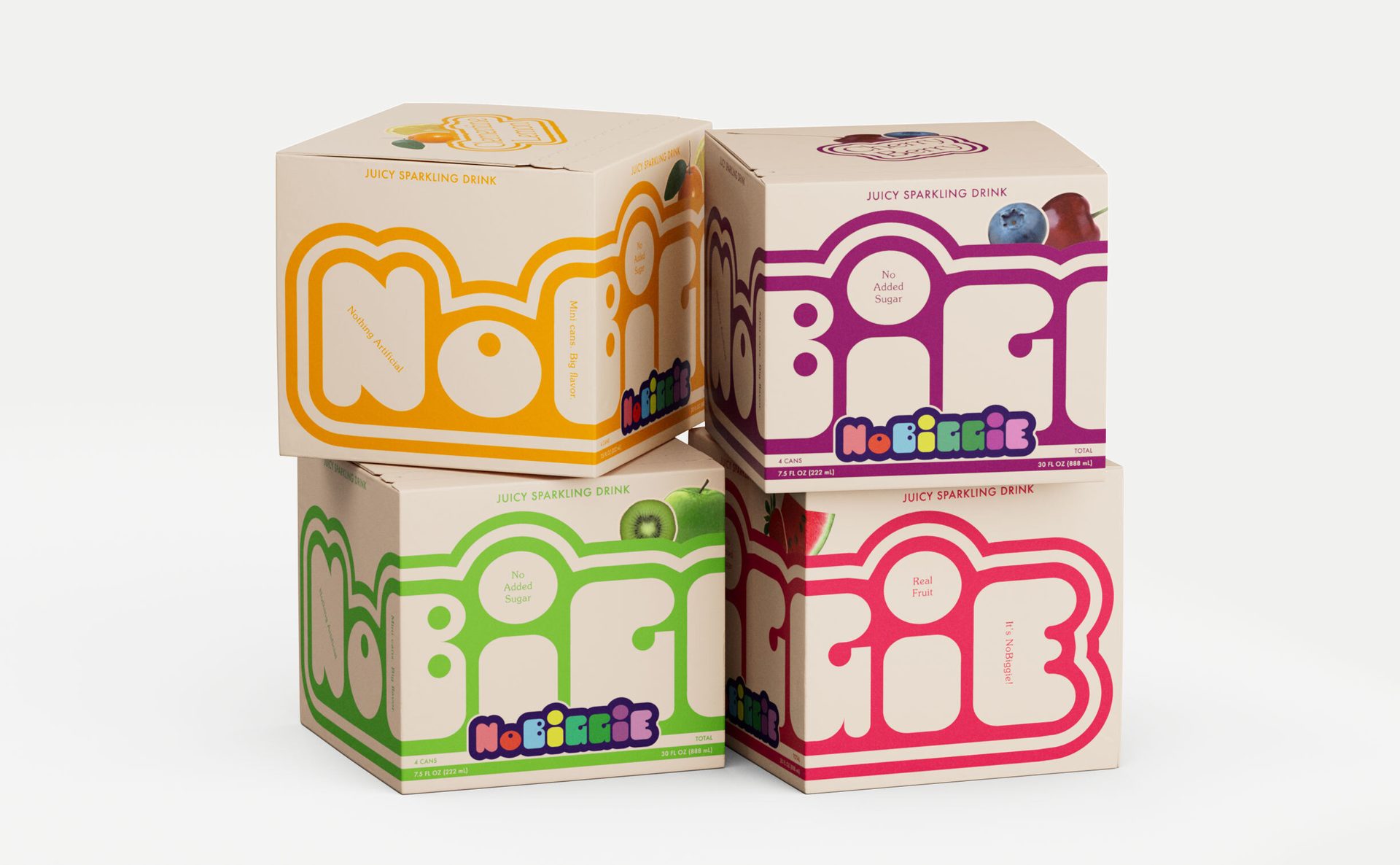
NoBiggie designed its secondary packaging to feel like an interactive experience, featuring jack-in-the-box-style insert with bold colors and oversized fruit illustrations.
(Image courtesy of NoBiggie)
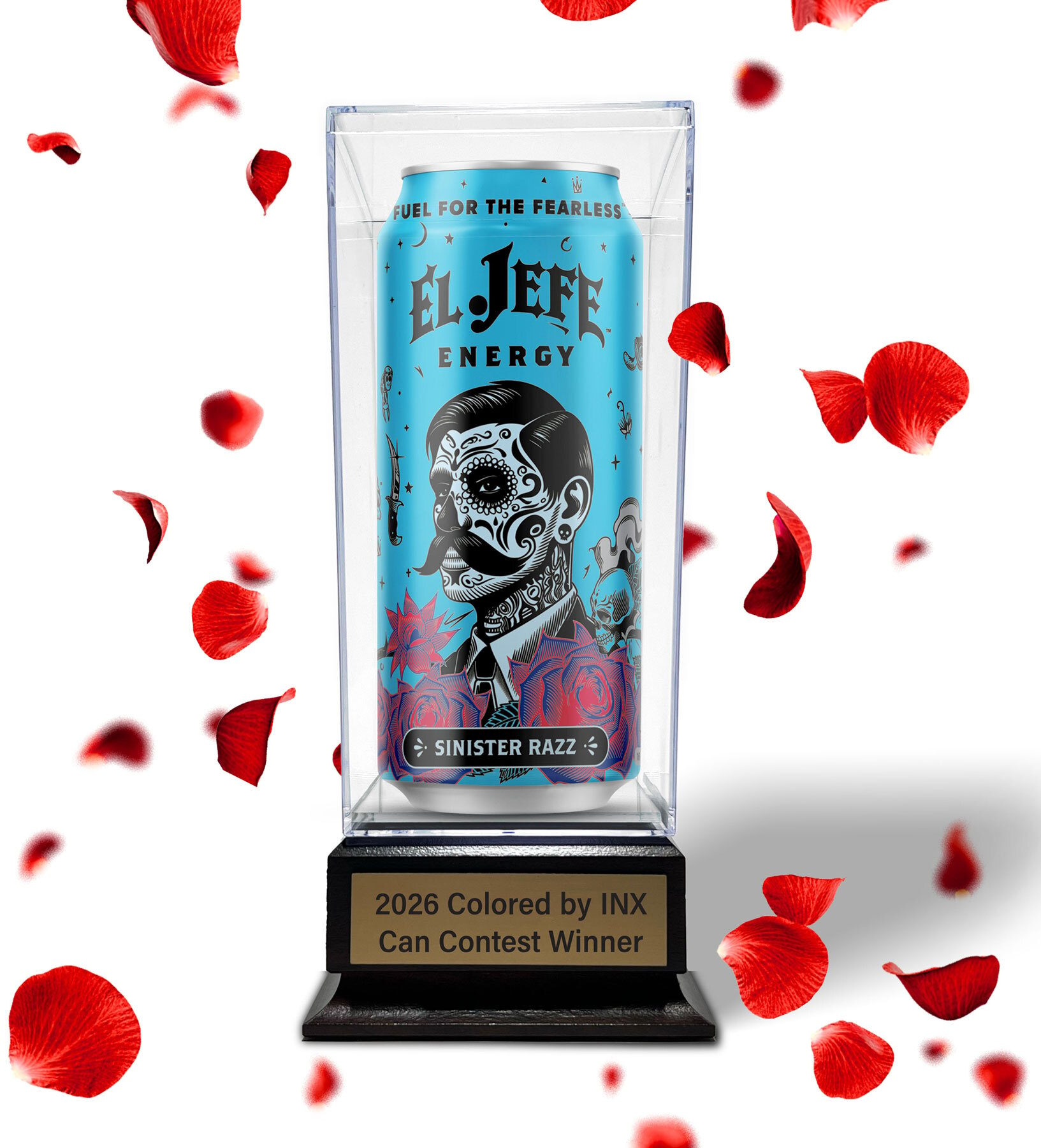
El Jefe Energy – Sinister Razz was named champion of the seventh annual Colored by INX Can Design Contest after earning the highest combined score from both the judges and public voting earlier this year.
(Image courtesy of INX International Ink Co.)
Ostrowski notes that inks and coatings have seen several advancements gain traction in the beverage market, pointing to technologies that support sustainability goals, production efficiency and packaging performance.
“One major area of focus is eco-friendly ink systems such as INX’s EcoCan platform, which is designed to support circular economy goals, reduce environmental impact, and offer third-party sustainability certification like Cradle to Cradle Certified,” he says. “Natural-based, high-performance inks like INXhrc are also on the rise, helping beverage-makers incorporate renewable materials without sacrificing print quality, durability or press performance. At the same time, low temperature curing technologies are gaining attention because they help reduce energy consumption, lower operating costs and support carbon-reduction initiatives.”
Ostrowski adds that beverage manufacturers are showing interest in inks and coatings that support recyclability, lightweight packaging and digital printing applications.
“Beverage brands want solutions that not only perform at high production speeds, but also help them meet sustainability commitments while maintaining strong shelf appeal and color consistency,” he says. “Together, these innovations help beverage-makers balance performance, efficiency, brand impact and sustainability.”
NoBiggie’s Atabek also notes the impact of multipacks on secondary packaging.
“One trend we are seeing is a move toward smaller individual serving sizes, but larger overall purchase occasions,” he says. “Consumers may want smaller cans or bottles for portion control, trial, or convenience, but they are often buying those products in multipacks. So, while the primary package may be getting smaller, the transaction size can actually get larger.”
Graphic Packaging’s Arnone further notes how portion control trends are influencing the packaging world.
“Health, wellness and changing consumption habits are also influencing pack formats,” he says. “The rapid growth of smaller can sizes — particularly minis in soft drinks — and smaller multipacks reflects demand for moderation, portion control and lifestyle flexibility.”
Economic impacts also are prompting consumers to turn to multipacks at an increasing rate.
“Many consumers are turning to bulk formats and variety packs to manage spend while still accessing choice, allowing them to try multiple flavors or products without committing to larger single-SKU packs,” Arnone says.
Visually appealing
Beyond the impacts of consumer interests and concerns, secondary packaging must also act as the first interaction they have with shoppers.
“[B]rands continue to use secondary packaging as a platform for engagement through limited-edition graphics, collaborations and promotional campaigns,” Arnone says. “High-impact print and structural design help brands capture attention and create a point of differentiation in an increasingly crowded category.”
NoBiggie’s Atabek explains that brands are using secondary packaging to be part of the consumer experience.
“We are seeing more interactive elements, stronger brand storytelling, co-branding opportunities, and packaging that communicates the brand’s values more clearly,” he says. “There has also been good progress in reducing plastic through smarter use of paperboard sleeves, trays, wraps, and other bundling formats. The most successful examples are the ones that balance function, sustainability, and brand impact.”
Atabek further notes that secondary packaging offers brands a larger canvas to engage with consumers.
“That space can be used for storytelling, education, promotions, QR codes, partnerships, or seasonal and localized messaging,” he says. “It also gives brands a way to test different communication strategies without changing the primary package. For smaller beverage products especially, that extra real estate can be very valuable because the primary label only has so much room to do the work.”
NoBiggie, specifically, has taken this approach with its secondary packaging.
“NoBiggie’s secondary packaging was designed to feel like an interactive experience, not just a beverage box,” says Ali Weiss, NoBiggie co-founder and CEO. “The moment you rip open the top, you’re greeted by a bright, playful jack-in-the-box-style insert with bold colors and oversized fruit illustrations. Flip it over, and it transforms into a game board or activity that extends the NoBiggie experience beyond the last sip.
“From word searches and ‘Would You Rather?’ games to paper airplanes and fortune tellers, each pack creates a small moment of surprise, connection, and play for kids (and anyone else who joins in on the fun),” she continues. “We wanted the packaging to extend the joy of the product itself and turn an everyday treat into something memorable and shareable.”
Weiss explains that this approach was motivated by designing packaging that focused on the kids compared with designs that feature nutrition callouts, which are more parent oriented.
“We drew inspiration from the kinds of experiences kids used to obsess over: cereal box prizes, Cracker Jack surprises, little discoveries that made opening the package part of the fun,” she says. “We wanted the box to spark imagination, conversation, and play long after the drink was gone.”
This allowed the brand to really highlight its true spirit, she adds.
“The packaging captures the spirit of NoBiggie: joyful, playful, colorful, and made unapologetically for kids first,” Weiss says. “From the tiny cans to the bold graphics and interactive surprises, every detail is designed to bring a little more fun, connection, and sparkle to everyday moments.”
“Secondary packaging needs to protect the product, merchandise well, and support the brand on shelf. The best solutions are the ones that reduce unnecessary material without making the pack feel cheap or less effective.”
– Aytunc Atabek, co-founder and chief operating officer at NoBiggie
Enhancing branding
When it comes to secondary packaging, experts also highlight how it can be used not just for start-ups but to enhance legacy companies.
“One of the biggest shifts in recent years is how brands are approaching differentiation: finding smarter ways to stand out on shelf without significant new investment,” Graphic Packaging’s Arnone. “Rather than relying on entirely new formats, many are prioritizing renovation: evolving existing packaging systems to deliver a more premium, distinctive look while maintaining operational efficiency.
“We’re seeing this in practice with brands that have successfully refreshed legacy products by rethinking structural design and materials, enhancing shelf presence and elevating brand identity while continuing to run on existing equipment,” he continues. “By leveraging paperboard multipacks and refining pack structure, these brands can achieve a more premium look and improved sustainability profile without adding complexity or capital investment.”
Structural enhancements brands are employing include rounded corners, cleaner silhouettes and simplified pack designs, he adds.
“These updates not only improve visual appeal but also enhance the consumer experience, all while working within current production footprints,” Arnone says. “Ultimately, this reflects a broader shift toward working smarter — using design, materials and existing systems more strategically to balance differentiation, cost and performance in a highly competitive market.”
As the first branded touchpoint for consumers, Arnone emphasizes what a critical role secondary packaging plays.
“Inclusive packaging features, such as embossed braille, improve accessibility and ensure a broader range of consumers can interact with the product,” he says. “Immersive or experiential packaging, including augmented reality (AR), allows brands to layer digital storytelling and interactive content onto the physical package.
“Intelligent or connected packaging uses technologies like NFC tags and QR codes to extend engagement beyond the pack,” Arnone continues. “For example, Graphic Packaging partnered with BERO on the launch of its non-alcoholic brew, providing paperboard multipacks with unique QR codes printed on the inside using high-speed print technology. This enabled enhanced traceability while also connecting consumers to BERO’s loyalty program, Club BERO, offering exclusive content and experiences.”
Arnone explains that taking these approaches can help brands create packaging that deliver visually while also are accessible, connected and engaging.
“While brands ultimately own the digital user experience behind these interactions, partnering early with packaging experts can help ensure the physical and digital elements are seamlessly aligned,” he concludes.
Packaging News …
OLIPOP reveals new visual identity
OLIPOP announced the launch of The Feel Good soda, a new creative platform that will roll out alongside a new visual identity, refreshed packaging and a national advertising campaign. This launch marks the company’s next phase of growth, bringing sharper brand expression across the shelf and elevating what sets OLIPOP apart: exceptional taste and science-backed ingredients and product experience you can feel good about, it says. For the first time ever, OLIPOP has refreshed its packaging across its 6-gram Fiber Line, including 12-ounce cans, multipacks, sleek cans, minis and variety packs. Rather than reinventing the cans, the updated design amplifies the familiar elements consumers already love, drives distinction within the functional soda category, all while highlighting flavors, ingredients benefits and key product information, the company says. The new visual style features hand-drawn illustrations inspired by the late ’60s and early ’70s, adding a human touch to the packaging. OLIPOP’s refrigerated 9-gram Fiber Line remains unchanged and continues to be available in stores. As part of the refresh, OLIPOP also made updates to a small number of classic flavors based on consumer feedback. Classic Root Beer [CA1] [JJ2] and Ginger Ale now feature a touch more carbonation, while Lemon Lime and Vintage Cola received both additional bubbles and subtle flavor adjustments to better reflect traditional soda profiles. Additionally, Ridge Rush has been renamed Citrus Rush to better reflect its bright citrus flavor. drinkolipop.com/
BACARDÍ Gold Rum celebrates global football
With global football excitement building and fans preparing for watch parties and celebrations, BACARDÍ unveiled a limited-edition BACARDÍ Gold Rum collectible bottle designed to capture the energy of the moment and elevate at-home and on-premise entertaining. The limited-edition BACARDÍ Gold Rum collectible bottle is inspired by the energy and excitement of global football celebrations, the company says. The design features stadium-inspired artwork with bold foil and varnish detailing, created to capture the passion of the sport and elevate watch parties and gifting moments. The bottle is intended as both a display-worthy collectible and a celebration piece for fans. BACARDÍ Gold Rum is aged in toasted oak barrels for a smooth, rich flavor with notes of vanilla, almond, and light oak, making, it says. Available at retail locations nationwide, the collectible bottle has a suggested retail price of $12.99. www.bacardi.com/us/en/
Miller High Life refreshes packaging, logo
Miller High Life, the Champagne of Beers, rolled out refreshed packaging and logo updates that keep the look classic and familiar while refining a few key elements to better connect with longtime fans and today’s beer drinkers. Fans can rest easy knowing that the iconic High Life bottle will not change, the company says. Refreshed elements include crisper colors, the removal of the pin line on the soft cross logo, and a more prominent role for the beloved Girl in the Moon. High Life retains its iconic red while making the color sharper and more recognizable on shelf. The Girl in the Moon will continue to appear on the neck label of High Life bottles, and with the refreshed identity, will take on a more prominent role across packaging and marketing materials. The Girl in the Moon has been around since 1907 and has become an enduring icon. As a symbol of the Champagne of Beers, she’s lived everywhere from vintage ads to neon bar signs ― and long before the refreshed identity, she was already part of dive bar culture. Over time, she’s become an icon that people have made their own etched into mirrors and even tattooed by High Life fans. To honor that legacy, the Girl in the Moon now plays a bigger role across the brand’s refreshed packaging and look. www.millerhighlife.com/
Piper-Heidsieck unveils Marilyn Monroe Cuvée bottle
In celebration of the centennial of Marilyn Monroe's birth, Piper-Heidsieck Champagne unveiled a limited-edition cuvée honoring the historic bond between the French House and the Hollywood legend. Piper-Heidsieck has long celebrated audacity, glamour, and joyful expression — qualities embodied by Monroe. A true icon who charted her own path in Hollywood, Marilyn Monroe was a legendary lover of Piper-Heidsieck in the 1950s-60s; famously declaring “To Piper, my favorite.” She also was a symbol of daring femininity, becoming a producer and founding her own production company. The Marilyn Monroe limited-edition release includes 750-ml bottles featuring a striking portrait of Monroe, created in partnership with her estate, reflecting her enduring influence and connection to Piper-Heidsieck. The label, in the House’s signature red, features a vibrant contemporary portrait of the star, while her hot-stamped signature adds a refined, collectible touch. The result balances modernity, glamour, and legacy; true to the spirit of the Maison, it says. The limited-edition Marilyn Monroe bottles will be available in select markets worldwide in 2026, while supplies last. In the United States they are available at noblemerchants.com for a SRP of $70.99. www.piper-heidsieck.com/en/